Adair Campos
Planning, research leadership and presentationI led the project plan, completed the competitor research, recruited the European energy experts, moderated all five interviews, led the synthesis and presented the work.
Forward-Looking Design · Research · Concept design
How European market research and synthesis with energy experts narrowed the product opportunity—and how that direction evolved from system logic and low-fidelity structure into a developed Energy Flow concept.
Project team & responsibilities
I led this three-month initiative within Sungrow’s European design team, working closely with Maria, our project manager and stakeholders at headquarters in China.
I led the project plan, completed the competitor research, recruited the European energy experts, moderated all five interviews, led the synthesis and presented the work.
Maria co-created the interview guide, observed and documented the sessions, contributed to the analysis and shared the conceptual design work.
The European design team and project manager collaborated on the opportunity and concept work. HQ China and the product managers reviewed the evidence and made the final product decisions.
Project planning · Competitive research · Participant recruitment · All five interviews · Synthesis · Presentation
Interview guide · Research artifacts · Analysis · Opportunity framing · Concept exploration
The work informed later Energy Flow improvements, but I do not claim this exact concept shipped or produced measured outcomes. Final product decisions remained with HQ China and the product managers.
Chapter 01 · Research & product direction
We moved from competitor patterns to energy-expert interviews, user roles, motivational positioning and the post-installation journey—building a clear reason to focus on Energy Flow before exploring the interface.
01 · Competitive landscape
We studied Fronius, SMA, Sonnen and SolarEdge through four lenses. The aim was not to copy features, but to understand how established platforms made complex energy systems useful to different audiences.
Installer products prioritised commissioning and technical control; homeowner products prioritised clarity and actionable insights.
Competitors adapted information and interactions to device constraints while retaining a familiar system model.
Forecasting and automation increasingly supported savings and hands-off energy management.
Colour, motion and information density were used to explain how energy was generated, stored and consumed.
02 · Expert interviews
Five European energy experts spanning Technical Sales, Partner Success and Product Management helped us examine user roles, handoffs, moments of truth and recurring product pain points.
Roles, company structures, goals and different levels of technical proficiency.
Touchpoints, handoffs and moments of truth across the residential journey.
Pain points and feature gaps around Energy Flow, alerts and monitoring.
Research context: The interviews brought together practical expertise from Technical Sales, Partner Success and Product Management across three European markets. We combined these perspectives with existing HQ research and previous European user studies.
03 · From interviews to roles
The synthesis first separated professional installers from plant owners. Within each role, company structure or personal motivation changed what “simple” and “valuable” meant.
Small companies often handled the complete installation and service journey; mid-size companies split work across specialists. Large utility teams were outside the residential focus.
Homeowners needed confidence, understandable value and a view of the system that could adapt from casual monitoring to deeper control.
These behavioural profiles translate the combined evidence into design lenses—not claims that every homeowner fits one fixed persona.
Focused on cost savings and simplicity; wants reliable insight without deep technical involvement.
Motivated by energy independence and long-term self-reliance; values clear visualisation and automation.
Enthusiastic about data, control and optimisation; prefers advanced settings and detailed system insight.
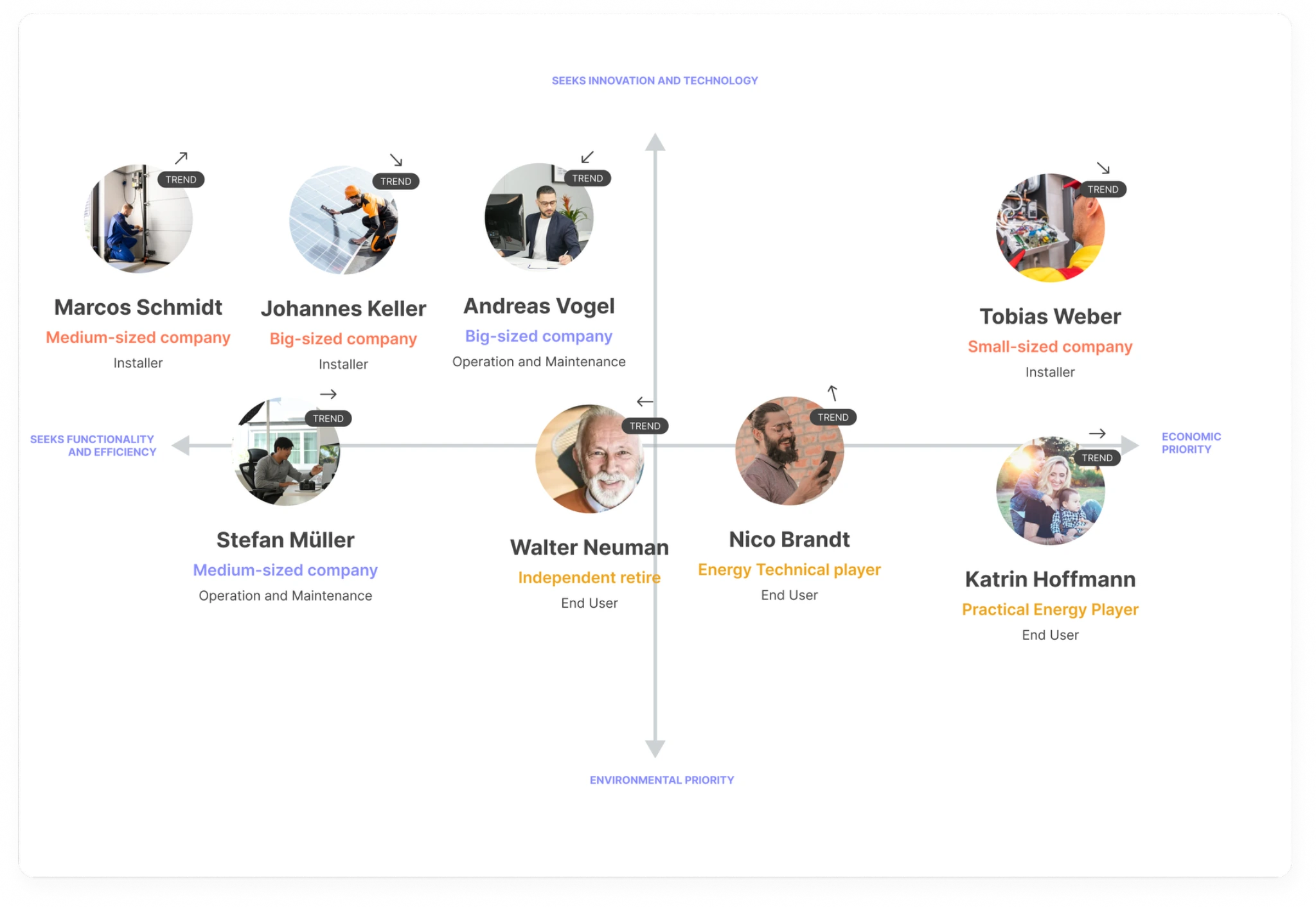
Placed installer structures and plant-owner motivations on the same environmental-to-economic and functional-to-innovative axes.
Positioning the opportunity
We mapped the competitor products onto the same motivational axes. The comparison suggested that the market was strongest around installer workflows, functional efficiency and technology-oriented users.
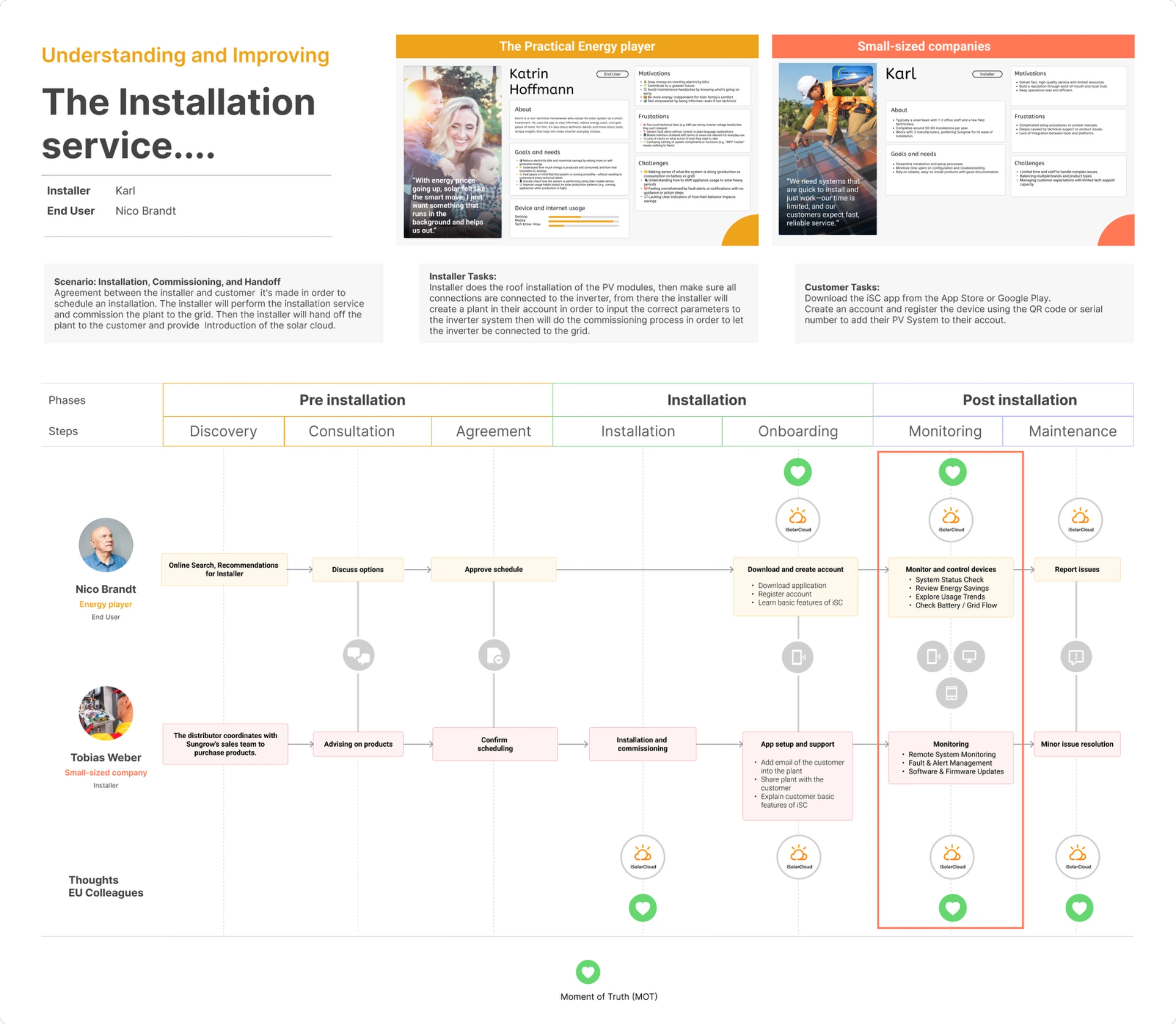
Mapped the handoff from installation to plant ownership and identified post-installation monitoring as a decisive moment of truth.
06 · Why Energy Flow?
The design focus was not chosen because Energy Flow was visually interesting. It sat at the intersection of an underserved audience, a high-trust journey stage and recurring monitoring problems.
Research outcome
This makes the transition honest: research narrowed the opportunity and established criteria, while concept design explored how those criteria could coexist in one adaptable interface.
Hover or focus a requirement to see the design implication. On touch devices, tap a card.
The interface should answer “Is everything working?” before presenting detailed measurements.
The handoff from research to design
Chapter 2 begins with the same four requirements in mind, then follows the work through system modelling, structural exploration, concept divergence and a developed direction.
Chapter 02 · Design evolution
The second chapter follows the decisions from technical system modelling to structural exploration, concept divergence and the developed direction.
Model the system
Before designing layouts, the work mapped different combinations of solar, grid, battery, EV charging and household demand.
The scenarios exposed a central constraint: a single static diagram could not accurately represent every installation. The structure needed to adapt while preserving a predictable hierarchy.
Hover or tap a system element
Devices and energy sources become easier to understand when their relationship to the home remains stable.
Establish the hierarchy
The early layouts tested whether the same hierarchy could survive increasingly complex household configurations.
Instead of refining colours or iconography, the focus stayed on system status, energy direction, household demand and the order in which secondary devices should appear.
These low-fidelity reconstructions make the structural decision sequence visible; the original project artifacts shown elsewhere remain the source material.
Diverge
The concepts tested more than visual style: they proposed two different ways of explaining a changing technical system.
Concept A made movement and energy activity more expressive. Concept B relied on clearer modules and progressive disclosure. The comparison exposed a useful tension between immediacy and scalability.
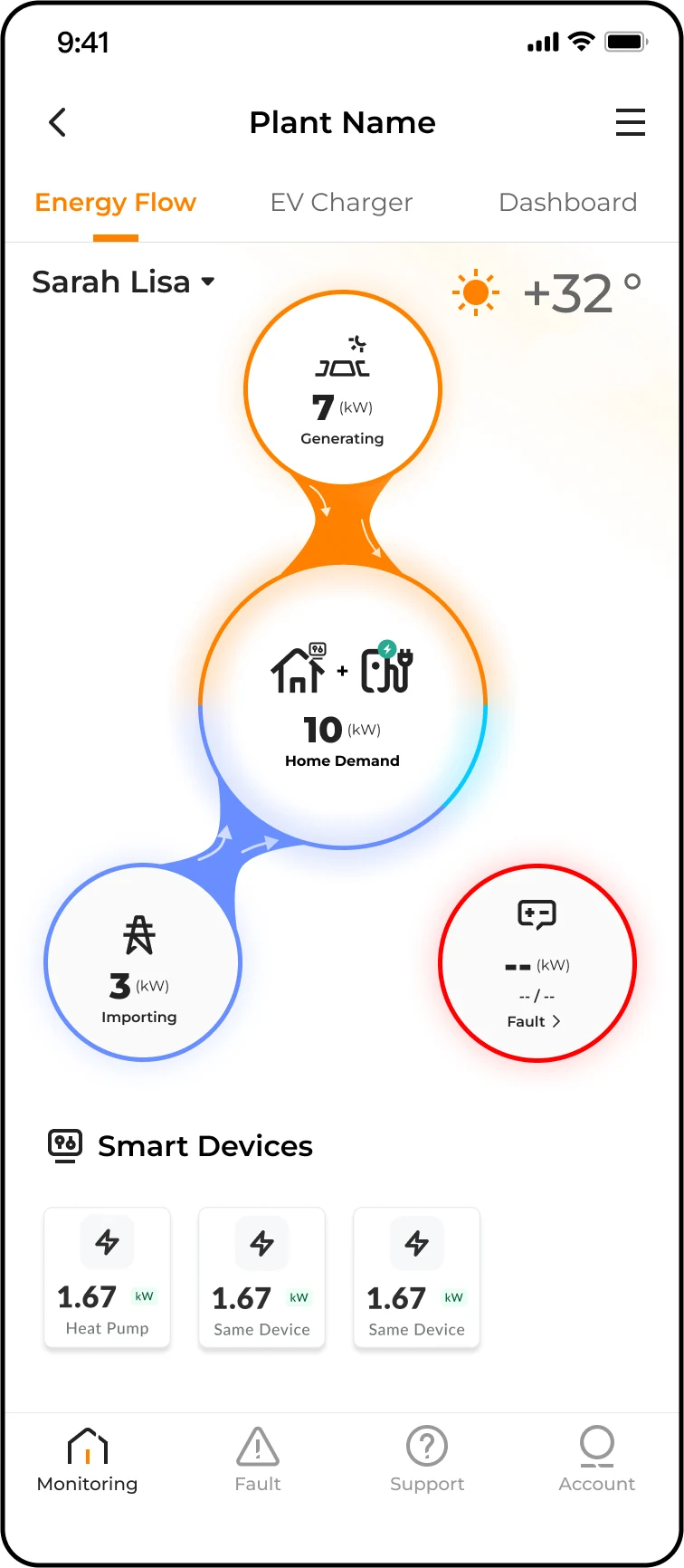
Expressive colour and movement make live activity immediately visible.
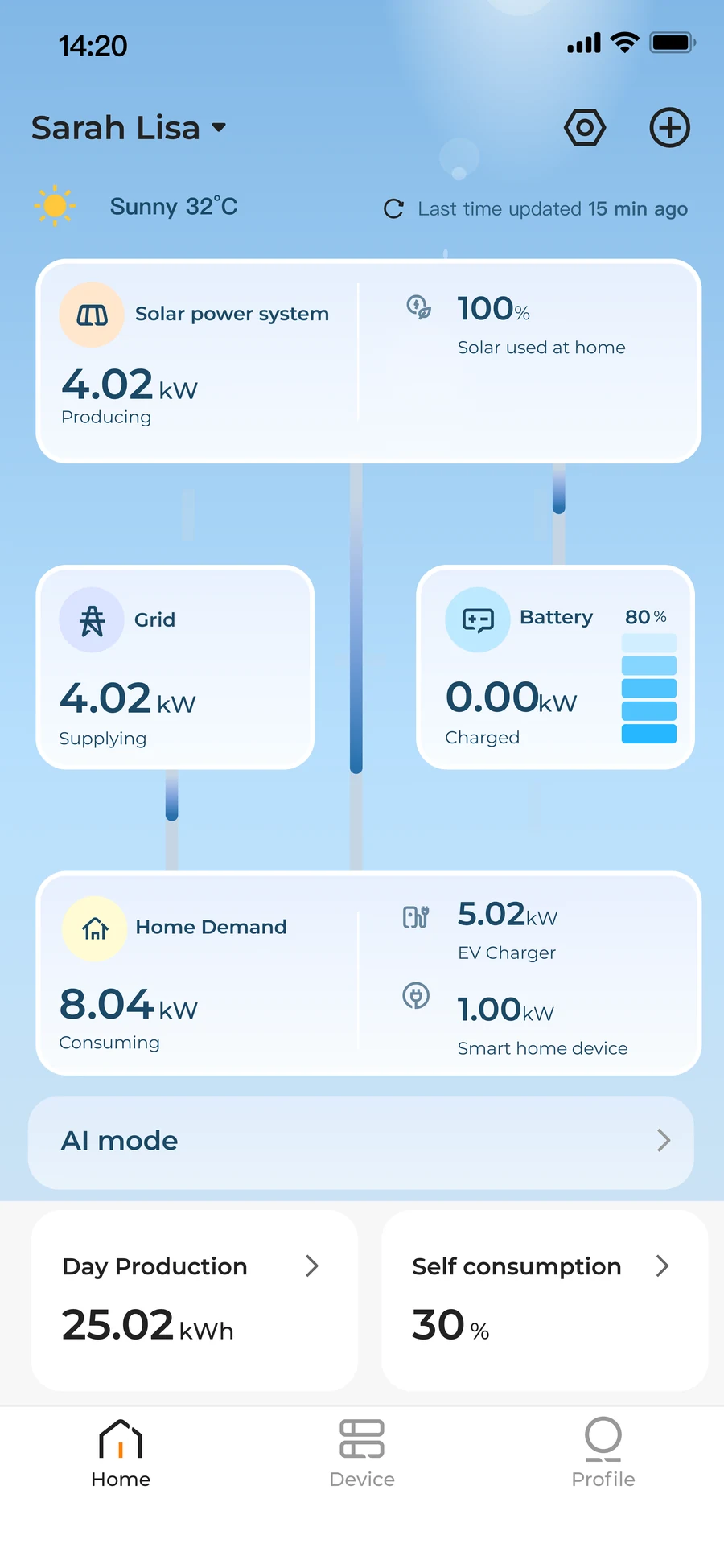
Clear grouping keeps the default understandable while allowing additional depth.
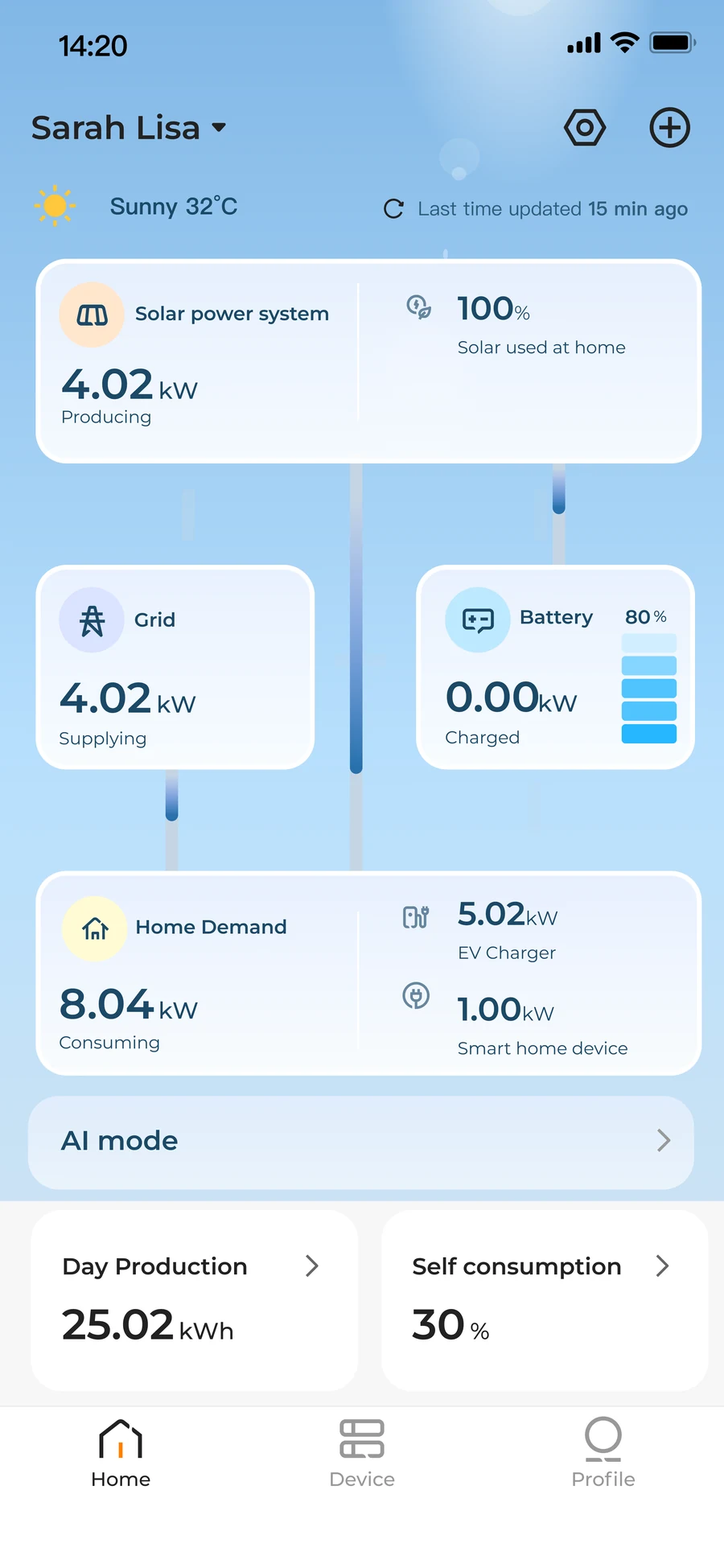
Develop the direction
The developed direction prioritised status, household demand and understandable system relationships while keeping deeper information available.
The concept remained a future product direction. The next step would have been direct comprehension and accessibility testing with homeowners and installers before implementation.
 01
02
03
04
01
02
03
04
Explain what is happening before presenting values.
Outcome & reflection
The three-month initiative gave the European design team a research-informed direction and helped shape later Energy Flow improvements. It did not establish that this exact concept shipped, and no measured customer outcomes are attributed to the work.